Sunday, November 20, 2011


Artists I admire.....


There are so many artists working in polymere that I intensely admire and take inspiration from that it would be impossible to list them--so I'll take the random approach and put the spotlight on Rebecca Watkins, who goes by the flickr name artybecca.


Rebecca's style is truly unique--you know her work the moment that you see it--and she is also one of the most consisitently generous artists on the web, sharing her secret techniques in detail. What shines in her gallery of style is a sweet and self-effacing humor, as demonstrated by her 'buttoned-up fish" series:


She apparently creates most of her distinctive pieces from scrap clay, letting the colors of the clay dictate the nature of the piece--a refreshingly unplanned approach very much in keeping with the meditative quality of her work. Much of her work is scribed and carved with an eye to following the patterns already extant in the clay. Sculptors like Michaelangelo famously claimed that they were merely freeing the form from the stone they carved, without conscious intention, and Rebecca does the same in the medium of polymer clay.


All of her work has a timeless, organic feel that invites the viewer to sit and rest awhile--doodle a bit and see what happens---and perhaps be surpised with the outcome. So often we struggle to 'create' something--get an idea or an image out--that it's good to remember that it's just as valid to relax and let the work create itself.


Have a creative and fun holiday..


Namaste,


Randee

Friday, November 11, 2011

Make your own neckwire


Don't you just hate it when you're just about to finish a piece, and you find you lack the findings?!!
I do--when I'm ready to go, I'm ready to go. The other day I had finished a lovely pendant, reached into the drawer--and no neckwire to put it on. That meant ordering online and waiting, or heading down to the local craft outlet and hope it was on sale.


But Wait! there's a third option........I'm going to just load these pics on and you can follow along; sorry I can't think of a more elegant way to do this, but you'll get the idea...


Hope you find this useful....


Namaste,


Randee


Monday, October 10, 2011

Waste Not! ALice Stroppel's Brilliantly simple (and simply brilliant) cane technique


You hear all the time about things 'going viral' on the web--and few places demonstrate this better than the polymer clay community. Case in point? Polymer Clay Daily--THE weblog of the polymer clay world, recently featured a link to the website of well-known polymer artist Alice Stroppel.

Alice has been doing face canes for years--almost everyone who works in PC is familiar with her work--but she also came up with a simple technique for using leftover canes--ends, failed pieces in a unique and innovative way; she demonstrated this at a recent retreat to her table mate--seemingly as a casual afterthought--and once the genie was out of the bottle, it travelled over the world with the speed of light.


In and of itself, the technique is so simple that most artists (like myself) are scratching their heads and saying, "why didn't I think of that?!",


whilst busily working away making the beautiful canes that she invented. Most polymer clay is fun--it's why we love it, and stay with it--but this technique is PC fun on steroids.


It has all the elements we love--Frugality (we hate to throw those old canes away, if there were only some good way to reuse them..) Beauty (just take a look) Ease of construction (The canes are ridiculously easy and fast to make) And above all, the sheer Serendipity of it--you never know what you're going to get, but odds are seriously in your favor it'll be great.


Alice, of course, could have reserved this knowledge and sold it in the form of tutorials, which most of us would gladly pay for; but instead, she chose to generously share it with the rest of the PC world for free. And this is one of the things that makes the PC world such a great place to be--a generous, sharing, supportive community of artists all encouraging and inspiring each other.


How cool is that.


I'll be teaching the Stroppel Cane technique at the November meeting of the Austin Polymer Clay Guild on Saturday, November 5th at 2pm at the Ralph Yarborough Library, 2200 E Hancock Drive. Please check our yahoo group and facebook page for details and supply lists.


Namaste,


Randee


Thursday, September 22, 2011

Julie Picarello Workshop


I don't know how longs it's been since the Austin Guild hosted a visiting Artist workshop, but it must have been too long!


This last weekend, some very fortunate members of the guild were able to attend two amazing days of instruction with JuliePicarello of Yellow House designs, and follow her down the lazy river of polymer clay.
Though she had considerable difficulty arriving--after months of drought, wouldn't you know it, an errant thunderstorm over Dallas caused her plane to divert to Oklahoma city, and she didn't get to her hotel in Dallas until 3a.m.--She arrived bright and chipper at the classroom space and went to work.
Now I must confess that I have only taken one polymer clay class in my life, years ago, and really had no idea what to expect; but whatever expectations I had or lacked, she blew them all out of the water. Not only is she an incredibly knowledgeable, organized and lucid teacher, she is also one of the nicest people you'll ever want to meet. Up close and personal, her work is stunning, flawless in execution and finish, and her teaching style is incredibly easy to follow. Even the least experienced of us was able to complete work worthy of boast. (One of the cooler aspects of Julie's take on colors--everyone mixed up their own blends following her basic process--was that almost everyone in the room, consciously or not, ended up making tiles that matched what they were wearing).


The workshop went step by step through her signature technique, "Lazy River Mokume Gane", and all long the way she filled us in with dozens of tips and tricks on how to get perfectly smooth and rounded tiles, how to cut one's clay for absolutely precise joins, how to texture clay with the simplest of materials; on the second day, she focused on finishing the work, and for those of us new to drilling, showed us the niftiest tricks for getting your work drilled clean and straight--which is not nearly as easy as it looks! She also shared some information that many of us didn't know--that for example, no polymer clay is fully cured until it reaches 300 degrees, despite what the manfacturer recommends-- the lower temperatures cited on the package are to protect the colors from changing--who knew?!


Most importantly, however, for two days, as she guided us through all the steps to making beautiful work, she was unfailingly gracious, kind, and encouraging. She made even brand new clayers feel wonderful about their efforts, and all without a hint of insincerity--when she told you your work was lovely, you believed it because it was true. She empowered everyone in that room, gave them the confidence to go forth and try new techniques--and that is what great instruction is all about; striking the sparks that catch into creative fire, long after the teacher has gone her way.


Wednesday, September 14, 2011

The shy Artist


I have a friend--I'll not mention names, because she's a self-effacing sort. This despite the fact that her work is manifestly brilliant, meticulously crafted and just sings with a unique voice.


She hardly ever publishes her work--for that matter, when she brings it to meetings she simply slides it onto the show and tell table without comment, leaving it for the rest of us to discover and squeal over.

I've noticed that this --for the lack of a better term--reluctance, to promote one's work-- is not unique to this lady; several polymer artists I know, and whose work I greatly respect, share the same trait. For some reason, we feel we have no right to claim that our work is in fact 'real' art; that we should be legitimately proud of it.


And I wonder; do other artists in other fields suffer from the same inability to promote their work? Is it because the field of polymer clay is overwhelmingly women, who tend to be diffident about seeking recognition? Would we feel any different about displaying our work if it were from longer established medium, like sculpture, painting, photography? It's a puzzle to me--because the work is so good, so exciting, and in a new field like polymer clay, all of us have the potential to be the new Picassos, Vermeers, and Monets.

Polymer clay is still the undiscovered country--and everyone of us who work in it the pioneers. There are some upsides to this hiding the light beneath the bushel--as a group, polymer clay artists tend to be the most supportive and sharing people I've ever encountered---if jealousies and rivalries exist, they are handled with the utmost civility--I've not witnessed the kind of turf wars made famous by Renaissance painters, or modern photographers. I've not heard many artists dissing the work of others--even in their most unguarded moments.


These things are all to the good--but maybe we could all allow ourselves the luxury of a bit more pride--a sense that we are in fact legitimate artists doing new and wonderful things--and blazing the trails for those we hope will follow.


Namaste

Sunday, July 3, 2011

July meeting- Pinch Petals


This month we had a fun little project. We learned how to make pinch petals. We started out by making a nice pastel rainbow blend. Taking a slice off of a rainbow skinner blend, we stepped it down with a block of translucent. It's amazing how little of the original blend you need to tint the translucent.
the next step in the process is to roll the blend into a snake, with the color blend running from head to tail. Notice how in this example the color is not thoroughly blended? It should make for some interesting petals!
Can't wait to see how these all turn out! I'm hoping next month for show and tell we will have many pinch petals leis to ohh and ahh over!

Yore Cheatin' Heart Gradient Blend


All of us owe a debt to Judith Skinner that we can never repay: She originated the idea for a seamless airbrushed-looking color blend that is the basis of almost every worthwhile technique involving color. Her method, available anywhere on the net for free, has inspired countless variations; Here is one:


I like to find shortcuts to everything--and I hate to measure; I'm just having too much fun creating. This is true for the basic gradient blend as well-- the version I call, 'yore cheatin' heart'.
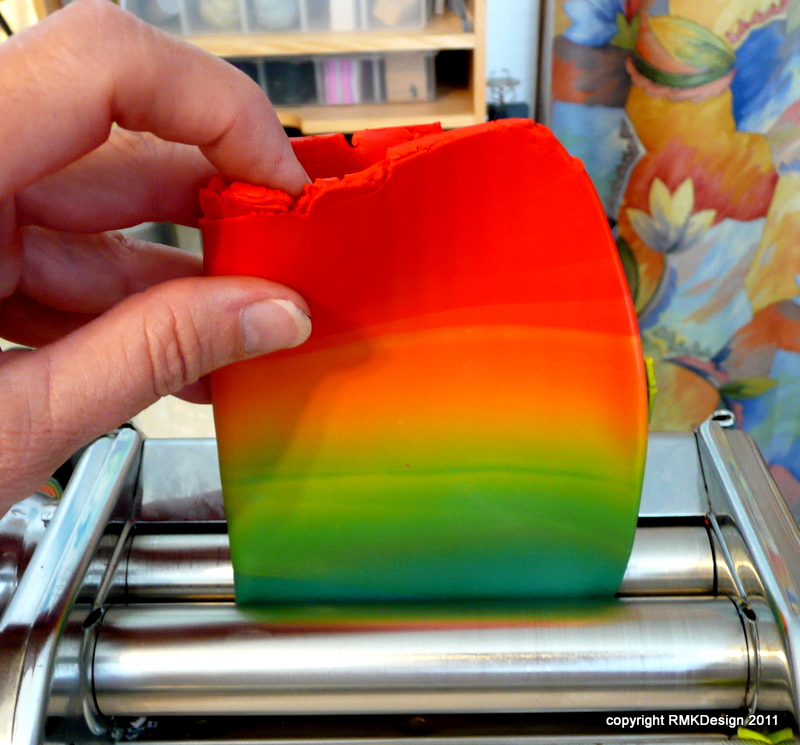
This method is exactly what it sounds like--a cheat; (And I'm sure the idea did not originate with me) but it's a good cheat. Rather than sheet, cut and measure triangles of clay, I simply take the colors I like best--in this case, the holy trinity of Red, Yellow and Blue, and condition them thoroughly--not really necessary, but it's always nice to warm up a bit, and there are few things more therapeutic than mindlessly cranking clay through a pasta machine. Once soft, I roll them into fat logs of the same length, and lay them out into a pattern I want; in this case, light in the center, so that I will get some nice secondary colors on each side as the blend develops.


I flatten these logs until they are a comfortable thickness to go through the pasta machine set on the widest setting without straining; never saw the benefit of blowing out those gears!


This sheet then goes through the pasta machine ONCE. This is where I pause for reflection--or possibly just a fresh water bottle :). I fold the big striped sheet from bottom to top, like colors together, but with a tweak: I offset the colors just slightly by angling the top of the sheet over the one beneath. I find that this just makes the blend go a bit faster--honestly, it probably only saves a few passes through the pasta machine--it would all end up as the same blend anyway, but as I said, I like to cheat just a little.


I send this folded sheet through the pasta machine, then settle down for the long haul; no more offsetting, I simply roll, fold and send through again on the same setting, over and over again, until the colors do what they do best--the clay, of course, expands lengthwise as it goes through the machine, but it also expands sideways--and would indefinitely, if not for the constricting sides of the machine; this is what creates the seamless blend. Formulas vary--a lot depends on the saturation of the colors, etc, but generally about 20 to 25 passes yields a good blend.


Sometimes, especially when I have light colors in the center of the blend, I find that it's a bit dark--and here is where polymer clay is so wonderful: I can simply add a pure color to the process by sandwiching it into the blend where needed; after a few passes, it shows through.


Once the blend is satisfying--the hardest part of polymer clay (all together now!) is knowing when to stop; I just pick a place. Then it's a simple matter of lengthening the blend by folding it one more time, and turning it one quarter turn so that the fold is on the side--still on the thickest (widest) setting of the pasta machine, and roll it through; this not only gives me more sheet to work with, it also 'polishes' the blend and gives it that perfect airbrushed look.


Where it goes from here depends upon the use I intend for it; If I'm making a plug for caning, it gets accordion folded and squared into a block; if I'm making a bold jellyroll spiral cane, I'll leave it as is; if I'm going for the gradient bulls eye cane, then I'll sheet it down to a medium thin setting.


Whatever use I find for it, There are few things more satisfying than contemplating a perfect rainbow blend; may you have as much fun with yours.


Namaste, Randee