Get this widget at roytanck.com
Thursday, May 24, 2012

Friday, April 13, 2012
Sharing Nicely

I love all the information that is available to the Polymer
Clay Artist. There are many free resources available to us on the internet in
the form of tutorials and video lessons. If you wish to spend a little money,
there are quite a few people offering tutorials for a fee, and some sites that
offer video lessons for a fee. And let us not forget all of the wonderful how-to
books that are on the market! How lucky we are to have all this information
available to us!
The problem that I run into is that all of the purchased
tutorials make the same request: to please not share the information, and to
give credit to the author. While I do strive to comply with this- after all, it
is a lot of work to write and develop tutes, and the author deserves to profit
from them- after a while, this process becomes rather cumbersome. Quite a bit
of my work involves multiple techniques that I have learned from many sources.
So, for a simple cabochon that I make, should I be crediting every person that
has influenced the work? “This cabochon
was produced using the Skinner blend technique by Judith Skinner, color theory
by Maggie Maggio, Hidden Magic technique as shown on Parole de Pate, Mold by
Penni Jo Couch, and finished with
techniques learned from Donna Kato.” Whew! Now that is a mouthful!
The other problem I run into is that I forget which methods
and techniques I learned from a purchased tutorial, and which ones I learned
from books or free from the internet. I
teach and share a lot of information- what if I accidentally share “secret”
info from a purchased tute? I am not in the habit of being secretive about my
work, and it is just too hard to remember what I can and cannot share. This is
not to say that I set out on purpose to teach “forbidden” information. I do try
and respect copyright and proprietary information. It’s just that after I incorporate
what I have learned and make my own items, it is hard to keep all the particulars
separate. The other thing I tend to do
is not follow instructions exactly. So if I tweek a tute, does it then become
mine to share?
Just thinking about all of this makes my head hurt. I guess
I’ll just have to do my best to not share “secret” information. And please, do
not sic the Polymer Tute police on me. I’m doing my best to be good!
Remember to Clay Nicely!
Nora
Tuesday, February 14, 2012
Polymer Clay and Mad Scientists
There's something about polymer that just begs people to experiment with it-- it brings out the explorer in just about everyone I know. Perhaps it's because this material attracts a certain type of person--the one who colors outside the lines, who is always asking themselves" What if?"
Because new products are being developed all the time to take advantage of the material's extrordinary versatility, the game changes constantly; and there is an unbelievable wealth of new techniques an d versions just itching to be realized. You will always see something new, as we are in the infancy of this artform, and it is worth the price of admission for that fact alone.
 d versions just itching to be realized. You will always see something new, as we are in the infancy of this artform, and it is worth the price of admission for that fact alone.
Some of the artists who work in the medium like myself, prefer an unorganized approach to the the game--Personally, I love surprises, and in Polymer, almost all of them are good ones. Like many of the greatest discoveries of Science, happy accidents abound; the piece that was thought irrevocably burned turned out to be a beautiful new way to control the color, giving depth and interest to an otherwise pedestrian piece of work, as in these 'Deeply Cured' bangles:
Total accident--but they opened the door to another technique.
Other artists have a far more methodical approach, keeping meticulous notes and photographing their processes, to the undying gratitude of the more free-spirited among us--the comparisons and reserach that they publish saves the rest of us enormous amounts of time and effort, and enables the entire polymer clay community to take another giant step forward.
Roberta Warshaw, a wonderful polymer artist http://www.etsy.com/people/RobertaWa out of Boston, recently put up some shots on her flickr stream, detailing the differences in the two major brands of inks which can be used to color the clay--I found this particularly inmportant, because it's nearly impossible looking at those tiny bottles of intense color to know how they'll look on the clay.
Many of us use what is locally available--Ranger brand, for example, is nearly everywhere--but is helpful to know if there' something more suitable for a particular project that you might want to make the effort to find. Pinata inks by Jac quard are a little more difficult to track down, but when you look at the difference in hue and intensity, it does make a difference--sometimes the difference between the absolutely perfect, and the well, maybe it will do.

On the right, what the Pinata Inks look like on pure white clay:
and below, the Ranger Inks on the same surface:
Huge difference-- now I'm not saying that one is necessarily better than the other--all materials have their uses--but I find definitely gravitate to the brighter colors.

Thanks so much, Roberta! This will come in handy for all of us!
Namaste,
Randee
Saturday, December 24, 2011
Twists on Technique
One of the fabulous things about polymer clay (and the internet) if that the material is flexible enough to allow for a range of experimentation; people are constantly taking a technique which they have learned, and adding to it--sort of like that old game of 'telephone', where a word or phrase passes from person to person, until it comes full circle in a nearly unrecognizable form.
Last year I published a tutorial on making faux twigs, after much experimentation on my own; I, of course, was influenced by looking at other artists--Kim Cavender, especially.
My take on the faux twigs was in pursuit of realistic looking lightweight polymer pieces that could be included in jewelry--and one of the weaknesses of the tutorial was that it required the artist to drill after curing--something that many people are neither set up for, nor comfortable with.
Of course I included sugggestions such as wirewrapping to add the elements, but still....
One of the fabulous things about polymer clay (and the internet) if that the material is flexible enough to allow for a range of experimentation; people are constantly taking a technique which they have learned, and adding to it--sort of like that old game of 'telephone', where a word or phrase passes from person to person, until it comes full circle in a nearly unrecognizable form.
Last year I published a tutorial on making faux twigs, after much experimentation
 on my own; I, of course, was influenced by looking at other artists--Kim Cavender, especially.
My take on the faux twigs was in pursuit of realistic looking lightweight polymer pieces that could be included in jewelry--and one of the weaknesses of the tutorial was that it required the artist to drill after curing--something that many people are neither set up for, nor comfortable with.
Of course I included sugggestions such as wirewrapping to add the elements, but still....
So I was completely delighted the other day to get a lovely email from an artist in Italy, who had come up with a brilliant and beautful way to overcome the drilling problem:
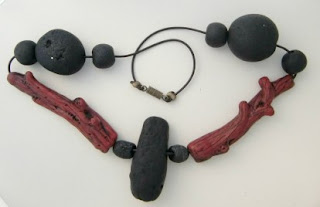
 Her screen name is Primatoide Futile, and her work is notable for the sophistication that she achieves with simple palletes and shapes--but what knocked me out was her elegant solution for the non-drillers among us--she simply combined two techniques--creating hollow tubes in polymer, then creating the twig around it;
Voila!! A twig that can be strung lengthwise, easy-peazy.
Prima didn't say, but I suspect that she cures her hollow tubes after creating them on a knitting needle or other armature, then adds the raw clay to the surface, and molds and textures it
as instructed in the tutorial; the look is smashing.
As always, I learn as much or more from my students than they do from me....
Namaste,
Randee
Sunday, November 20, 2011

Artists I admire.....
There are so many artists working in polymere that I intensely admire and take inspiration from that it would be impossible to list them--so I'll take the random approach and put the spotlight on Rebecca Watkins, who goes by the flickr name artybecca.
Rebecca's style is truly unique--you know her work the moment that you see it--and she is also one of the most consisitently generous artists on the web, sharing her secret techniques in detail. What shines in her gallery of style is a sweet and self-effacing humor, as demonstrated by her 'buttoned-up fish" series:

She apparently creates most of her distinctive pieces from scrap clay, letting the colors of the clay dictate the nature of the piece--a refreshingly unplanned approach very much in keeping with the meditative quality of her work. Much of her work is scribed and carved with an eye to following the patterns already extant in the clay. Sculptors like Michaelangelo famously claimed that they were merely freeing the form from the stone they carved, without conscious intention, and Rebecca does the same in the medium of polymer clay.
All of her work has a timeless, organic feel that invites the viewer to sit and rest awhile--doodle a bit and see what happens---and perhaps be surpised with the outcome. So often we struggle to 'create' something--get an idea or an image out--that it's good to remember that it's just as valid to relax and let the work create itself.

Have a creative and fun holiday..
Namaste,
Randee
Friday, November 11, 2011
Make your own neckwire
Don't you just hate it when you're just about to finish a piece, and you find you lack the findings?!!
I do--when I'm ready to go, I'm ready to go. The other day I had finished a lovely pendant, reached into the drawer--and no neckwire to put it on. That meant ordering online and waiting, or heading down to the local craft outlet and hope it was on sale.
I do--when I'm ready to go, I'm ready to go. The other day I had finished a lovely pendant, reached into the drawer--and no neckwire to put it on. That meant ordering online and waiting, or heading down to the local craft outlet and hope it was on sale.
But Wait! there's a third option........I'm going to just load these pics on and you can follow along; sorry I can't think of a more elegant way to do this, but you'll get the idea...


Hope you find this useful....
Namaste,
Randee
Monday, October 10, 2011
Waste Not! ALice Stroppel's Brilliantly simple (and simply brilliant) cane technique

You hear all the time about things 'going viral' on the web--and few places demonstrate this better than the polymer clay community. Case in point? Polymer Clay Daily--THE weblog of the polymer clay world, recently featured a link to the website of well-known polymer artist Alice Stroppel.
Alice has been doing face canes for years--almost everyone who works in PC is familiar with her work--but she also came up with a simple technique for using leftover canes--ends, failed pieces in a unique and innovative way; she demonstrated this at a recent retreat to her table mate--seemingly as a casual afterthought--and once the genie was out of the bottle, it travelled over the world with the speed of light.

In and of itself, the technique is so simple that most artists (like myself) are scratching their heads and saying, "why didn't I think of that?!",
whilst busily working away making the beautiful canes that she invented. Most polymer clay is fun--it's why we love it, and stay with it--but this technique is PC fun on steroids.
It has all the elements we love--Frugality (we hate to throw those old canes away, if there were only some good way to reuse them..) Beauty (just take a look) Ease of construction (The canes are ridiculously easy and fast to make) And above all, the sheer Serendipity of it--you never know what you're going to get, but odds are seriously in your favor it'll be great.
Alice, of course, could have reserved this knowledge and sold it in the form of tutorials, which most of us would gladly pay for; but instead, she chose to generously share it with the rest of the PC world for free. And this is one of the things that makes the PC world such a great place to be--a generous, sharing, supportive community of artists all encouraging and inspiring each other.
How cool is that.

I'll be teaching the Stroppel Cane technique at the November meeting of the Austin Polymer Clay Guild on Saturday, November 5th at 2pm at the Ralph Yarborough Library, 2200 E Hancock Drive. Please check our yahoo group and facebook page for details and supply lists.
Namaste,
Randee
Subscribe to:
Posts (Atom)